






NEWS
|
IN MEMORY OF JOHN MCLUCKEY
John passed away on April 13, 2012 after a long
battle with cancer. John retired from Boeing on April 1, 1998 as
President of Boeing Space Systems. Most of the members of our group will
recall John for his leadership of Autonetics where he was an integral
part of our professional experience at Anaheim. After retirement, John
did not forget his Autonetics roots and played a major role in the
design and construction of the Autonetics Monument. He will be missed by
the Autonetics retiree community. Follow this link to read the article
from the Boeing News summarizing his career which was published shortly after his death.
|
AUTONETICS MONUMENT
As those of you who are able to attend our
lunches know, as Boeing vacates the Anaheim site, a group of Anaheim alums
thought it would be appropriate to leave some sort of monument on the site to
commemorate what has been accomplished there. This group has been working
diligently with the Boeing and the city of Anaheim to this end. Due to
complicating factors, achieving this has not been straight forward. However, all
the hard work came to fruition on Aug. 3, 2010 with the formal dedication of the
monument. This date was chosen as it was the 52nd Anniversary of the first
submarine to transit under the North Pole which was made possible by the use of
an Autonetics Inertial Navigation System. The dedication was attended by
representatives of Boeing, retired Autonetics management, the City of Anaheim
and hundreds of Autonetics retirees.
For those of you not able to attend the
dedication and wishing to visit the Monument, it is located at 3195 E. La Palma.
(See satellite view below.)
In
addition, the City of Anaheim has agreed to rename a street in the old Autonetics complex in recognition of history of the location. The street
formerly known as Orchard Way has been renamed Autonetics Way. (Top right of
satellite view.) Additionally, the
on site roadway adjacent to the monument has been named Autonetics Place. To
view photographs of the Monument, follow this link.

AUTONETICS
ALUMS IN BOEING MANAGEMENT
Several Alums of the Autonetics Campus
have gone on to fill important management positions in the new Boeing
Organization. Three of them are listed below with a description of their Boeing
responsibilities. We hope that their success in Boeing can be attributed in part
to their Autonetics experience.

Jim Albaugh - Jim is executive vice
president of The Boeing Company and president and chief executive officer of
Boeing Commercial Airplanes. He is responsible for all of the company's
commercial airplanes programs and related services. Named to this position
effective September 1, 2009, Albaugh, 59, is a member of the Boeing Executive
Council and serves as Boeing's senior executive in the Pacific Northwest. Note:
Jim has announced his retirement from Boeing effective 10/1/2012

Rick Stephens - Rick is Senior Vice
President, Human Resources and Administration for The Boeing Company. Stephens,
a 30-year Boeing veteran, also is a member of the Boeing Executive Council.
Named to this position in 2005, he
oversees all leadership development, training, employee relations, compensation,
benefits, Global Corporate Citizenship, and diversity initiatives at the
Chicago-based, $60.9 billion, 159,000-person commercial airplane and defense
company.

Debbie Rub - Debbie Rub is The
Boeing Company vice president and general manager of Missiles & Unmanned
Airborne Systems (MUAS), a division of the Boeing Military Aircraft
organization. Rub was appointed to this position in September 2010 and leads the
division comprised of four major businesses of Direct Attack, Cruise Missile
Systems, Terminal Missile Defense, and Unmanned Airborne Systems including
Insitu, a wholly owned subsidiary. The division is headquartered in St. Charles,
Mo.
Rub is responsible for leading a
portfolio of programs, including Joint Direct Attack Munition (JDAM), Small
Diameter Bomb (SDB), Harpoon, Aegis Standard Missile-3 (SM-3) Kinetic Warhead,
Patriot Advanced Capability-3 (PAC-3) Seeker, A-160 Hummingbird, ScanEagle®, and
IntegratorTM. Missiles and Unmanned Airborne Systems facilities are located in
Bingen, Wash.; Huntington Beach, Calif.; Huntsville, Ala.; Mesa, Ariz.; Puget
Sound, Wash.; and St. Charles, Mo.
BOEING NEWS
ITEMS OF INTEREST
Boeing taps salesman Conner to run commercial planes
SEATTLE (Reuters) - Boeing Co
(NYSE:BA) appointed a new head of its commercial plane unit on Tuesday,
turning to a veteran engineer-turned-salesman to help gain the upper hand in its
battle with Airbus for the $100 billion-a-year aircraft market.
The surprise move, just weeks before the Farnborough
Airshow, comes as Boeing attempts to ramp up production of its civil aircraft,
including the troubled 787, and regain its leading position in the key
single-aisle market after losing a large American Airlines order to rival
Airbus.
Boeing said Raymond Conner would be the new head of its
best-known unit with immediate effect, replacing another longtime Boeing
executive, Jim Albaugh.
Conner, 57, joined Boeing in 1977 as a mechanic and worked
his way up the company's engineering, supply chain and marketing groups to
become head of sales. Albaugh, 62, who came to prominence at Boeing's defense
operations, is to retire on October 1 -- three years before Boeing's standard
retirement age -- after 37 years with the company.
The move was greeted positively by industry analysts, who
applauded the appointment of a sales-oriented head in place of the
engineering-minded Albaugh.
"Commercial aircraft sales is a very customer-centric job,"
said Carter Leake, an analyst at BB&T Capital Markets. "Conner is more from
true-blue aircraft sales than Albaugh. Arguably Conner has touched more Boeing
customers than any person in the entire company."
SALES JOB
One industry source said Albaugh wanted to hand over the
reins now so that his successor would have a chance to represent Boeing at
Farnborough, one of the most important events in the company's calendar where it
will be under pressure to announce new orders.
"It's a good time to step aside and open the door to
increased effort on sales where Conner has most recently focused his attention,"
said Stifel Nicolaus analyst Stephen Levenson.
Conner was only recently appointed to his second stint in
the top sales job after a shake-up prompted by Airbus marching into core Boeing
territory last July and persuading American Airlines to buy 260 of its
narrow-body A320s, alongside 200 Boeing 737s.
The 737 is the work-horse for most airlines and Boeing's
biggest cash generator, but Boeing upset some customers by delaying a decision
on what to do with its replacement, eventually deciding to follow Airbus and
offer a revamped version, called the 737 MAX, instead of building an all-new
airplane .
Since the launch of the MAX last August, the quiet-spoken
Conner has led Boeing's rebound in the aircraft market and the company is
expected to outsell Airbus this year for the first time since 2006, largely on
the back of orders for the MAX.
After Farnborough, Conner must turn his attention to
Boeing's audacious attempt to ramp up production of its revolutionary,
carbon-fiber 787 to 10 a month by the end of next year from 3.5 a month now, as
well as oversee increased production of 737s and 777s.
In a memo to Boeing employees sent on Tuesday and obtained
by Reuters, Conner said he aimed to focus on delivering the planes in Boeing's
bulging order book.
"Our job going forward together in the near term is to stay
the course on the product and services strategies that have resulted in our
record backlog, and to turn up the gain on performance and execution to ensure
we meet our commitments," said Conner in the memo.
MANAGEMENT CHANGE
One analyst said Albaugh's retirement signaled a broader
process of management change at Boeing.
"The generational shift in Boeing management is now
almost done, with only CEO Jim McNerney left of the old guard," said Rob
Stallard at RBC Capital Markets. "Who succeeds him remains to be seen, but
Boeing now has two relatively new and capable executives heading each division,
and each could be vying for the top slot in due course."
Dennis Muilenburg took over as head of Boeing's defense,
space and security unit in 2009, when Albaugh left to take charge at the
commercial airplanes unit as the company looked for a steady hand to guide the
early production of the troubled 787 Dreamliner program.
Industry-watchers agree that Albaugh achieved that, while
he also brought the new 747-8 jumbo to market and presided over an unprecedented
labor agreement at Boeing's volatile Seattle-area plants.
Albaugh's support was key to Boeing's winning back a
multibillion-dollar U.S. Air Force contract to build 179 new refueling planes
that had been awarded to Northrop Grumman Corp
(NYSE:NOC) and its European partner, Airbus parent EADS.
"Realistically, he's accomplished everything he was trying
to do at Boeing Commercial Aircraft," said defense consultant Loren Thompson at
the Lexington Institute.
One senior industry official said Albaugh likely wanted to
exit Boeing at the "top of his game".
"He's run Boeing defense. He's run Boeing commercial, and
he's not going to be CEO at Boeing."
(Additional reporting by Tim Hepher in Paris, Karen Jacobs
in Atlanta, Andrea Shalal-Esa in Washington and A. Ananthalakshmi in Bangalore.;
Editing by Matthew Lewis, M.D. Golan and Richard Pullin)
BOEING OPENS NEW
NAVIGATION SYSTEM REPAIR LINE AT OHIO FACILITY
HEATH, Ohio, April 26, 2012 -- Boeing
[NYSE: BA] today marked the opening of a new
Electrostatically Supported Gyro (ESG) repair
line at the company's Heath facility. The new
line increases the capability of the skilled
workforce and equipment already in place for the
repair and maintenance of the U.S. Navy's
Electrostatically Supported Gyro Navigator (ESGN,
or Trident Navigation System).
"As the sole supplier of navigators for the
U.S. Navy's ballistic missile submarine fleet,
we believe this new line will allow for a
long-range sustainable advantage in product
maintenance while we develop the next generation
of ultra-high-precision inertial systems," said
Joe Carlin, vice president of Boeing subsidiary
Argon ST.
A key component of all Navy Trident
submarines, the ESGN, which started production
more than three decades ago, is the world's most
accurate inertial navigation system. The new
facility includes approximately 14,000 square
feet of space dedicated to the ESG Stable
Platform Housing refurbishment and test program,
as well as space for modification, repair,
maintenance and storage.
"Ohio class submarines have been patrolling
the world's oceans with the Trident II (D5)
missile system for 30 years, serving as a
credible strategic deterrence against enemies,"
said Rear Admiral Terry J. Benedict, director of
the U.S. Navy's Strategic Systems Programs. "The
Electrostatically Supported Gyro Navigator has
successfully supported this mission by supplying
the Trident Weapon System with critical
information."
Today's event also celebrated Boeing's
commitment to the Heath community. Boeing made
$4 million in improvements and upgrades at the
facility, which also received investments from
the Ohio Department of Development, the
Heath-Newark-Licking County Port Authority, and
American Electric Power. The Heath facility is
Boeing's Center of Excellence for maintenance,
repair and overhaul of guidance and navigation
systems, inertial instruments and platforms.
Under the current contract, Argon ST
employees are scheduled to conduct ESG repair
and maintenance at the facility until 2025.
A unit of The Boeing Company,
Boeing
Defense, Space & Security is one of the
world's largest defense, space and security
businesses specializing in innovative and
capabilities-driven customer solutions, and the
world's largest and most versatile manufacturer
of military aircraft. Headquartered in St.
Louis, Boeing Defense, Space & Security is a $32
billion business with 62,000 employees
worldwide. Follow us on Twitter:
@BoeingDefense.
|
BOEING TO UPGRADE
B-1 NAVIGATION SYSTEM FOR US AIR FORCE
OKLAHOMA CITY, April 9, 2012 -- Boeing
[NYSE: BA] has received a $55.3 million
production contract from the U.S. Air Force to
upgrade the B-1 Lancer navigation system. The
upgrade will replace the original navigation
hardware with a new ring laser gyro system.
"We are no longer using a spinning mass
gyro," said Rick Greenwell, B-1 program director
for Boeing. "The new inertial navigation system
uses a ring laser gyro with no moving parts to
wear out and repair. This upgrade will
dramatically increase system reliability."
Under the three-and-a-half year contract,
Boeing will deliver hardware modification kits
and perform retrofits at Dyess Air Force Base in
Abilene, Texas, and Ellsworth Air Force Base in
Rapid City, S.D. Initial aircraft modification
is scheduled to begin in January 2013 and be
completed by mid-2015.
Development program flight tests were
completed on July 13, 2011. Boeing will begin
purchasing upgrade kits immediately.
A unit of The Boeing Company,
Boeing
Defense, Space & Security is one of the
world's largest defense, space and security
businesses specializing in innovative and
capabilities-driven customer solutions, and the
world's largest and most versatile manufacturer
of military aircraft. Headquartered in St.
Louis, Boeing Defense, Space & Security is a $32
billion business with 62,000 employees
worldwide. Follow us on Twitter:
@BoeingDefense.
|
BOEING BRINGS NINE DECADES
OF AVIATION INNOVATION TO iPAD
CHICAGO, May 7, 2012 /PRNewswire/ -- Boeing
(NYSE: BA) announced today the launch of its
first official app for iPad, 'Milestones in
Innovation', now available on the App Store. The
app brings nine decades of aviation innovation
to iPad through beautiful imagery and an
interactive timeline.
(Photo:
http://photos.prnewswire.com/prnh/20120507/CG01513-a)
(Photo:
http://photos.prnewswire.com/prnh/20120507/CG01513-b)
"This is the history of Boeing as a digital
coffee table book," said Fritz Johnston,
Boeing's vice president of brand and
advertising. "iPad's amazing Retina display
makes it the perfect canvas to present this
visually stunning narrative."
Starting with Bill Boeing founding the
company in 1916 and culminating with first
delivery of the 787 Dreamliner, the free app
depicts advances that have transformed the world
and made Boeing one of the most respected
companies. The app also includes four videos
from Boeing's "Inspiration to Innovation" series
(www.boeing.com/stories).
In addition, Boeing recently began
distributing stories, photos, and videos through
Flipboard, Apple's 2010 App of the Year. To
follow Boeing on Flipboard users can search for
and select "BoeingStories" from that app's
content guide, which is accessible via the red
ribbon at the top of the screen.
Boeing is the world's leading aerospace
company and the largest manufacturer of
commercial jetliners and military aircraft. It
has customers in 150 countries and employs more
than 170,000 people across the United States and
in 70 countries.
The Boeing 'Milestones in Innovation' App is
available for free from the App Store on iPad or
at
www.itunes.com/appstore.
|
BOEING B-1 BOMBER
COMPLETES 10,000th COMBAT MISSION
OKLAHOMA CITY, Feb. 27, 2012 -- The Boeing
[NYSE: BA] B-1 bomber aircraft has completed its
10,000th combat mission. The heavy bomber
entered service with the U.S. Air Force on June
29, 1985, and has been in nearly continuous
combat for the past 10 years. The milestone
mission took off from a base in Southwest Asia
and was flown in support of operations over
Afghanistan before returning to base.
"The B-1 brings tremendous flexibility to our
nation's defense," said Lt. Col. Alejandro
Gomez, mission team lead. "In any mission, the
B-1 has the ability to loiter, dash, positively
identify targets, show force, and strike targets
precisely. Whatever our aircrews are asked to
do, they can perform with this aircraft."
B-1 crews in Southwest Asia fly a variety of
missions, including close air support for troops
on the ground, giving them cover and alerting
them to threats they cannot see. On-site
maintainers keep the fleet ready to fly.
"10,000 conventional combat missions for a
relatively small fleet of 66 B-1s is a major
milestone and a testament to the men and women
who built, sustain and modernize the fleet,
including the U.S. Air Force, Boeing and our
subcontractors," said Rick Greenwell, Boeing B-1
program director. "We continue to draw on
expertise and experience from across Boeing to
enhance our support of this amazing aircraft."
The B-1 bomber has advanced over the years as
it is modified for current needs. The aircraft
began as a nuclear bomber and moved into a
solely conventional role in the 1990s. It
carries the largest payload in the Air Force's
long-range bomber fleet -- during Operation
Iraqi Freedom, it dropped 40 percent of all
weapons while flying only 5 percent of the
sorties.
Today's B-1 can carry a mixed load of weapons
in each of its three bays. Its long range allows
it to base far from the conflict and loiter
unrefueled for long periods. Its swept wings
allow it to fly fast, slow, low or high as the
situation demands. With only four crewmembers
required, missions can rapidly be adjusted in
flight to keep up with adversaries. The radar
and targeting pod can be used for positive
target identification and the aircraft can
employ a variety of other weapons, including
Joint Direct Attack Munitions (JDAMs), Laser
JDAMs, Joint Air-to-Surface Standoff
Missiles-Extended Range, and BLU-129 warheads.
"The B-1 fleet and crews have readily adapted
to an ever-changing environment to accomplish
this 10,000th combat sortie milestone," said
Greenwell. "This aircraft has proven its ability
to continue to evolve and be effective well into
the future."
A unit of The Boeing Company,
Boeing
Defense, Space & Security is one of the
world's largest defense, space and security
businesses specializing in innovative and
capabilities-driven customer solutions, and the
world's largest and most versatile manufacturer
of military aircraft. Headquartered in St.
Louis, Boeing Defense, Space & Security is a $32
billion business with 62,000 employees
worldwide. Follow us on Twitter:
@BoeingDefense.
|
X-37B ORBITAL TEST VEHICLE
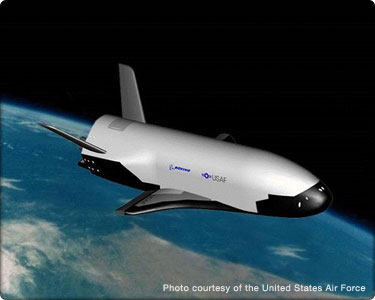
The X-37B Orbital Test Vehicle is an unmanned space
vehicle that will be used by the United States Air Force to explore
reusable vehicle technologies in support of long-term space
objectives. These objectives include space experimentation, risk
reduction, and concept of operations development. Boeing's
involvement in the program began in 1999.
The Rapid Capabilities Office of the U.S. Air Force is the
customer for the X-37B Orbital Test Vehicle. The program
transitioned to the U.S. Air Force in 2004 after earlier funded
research efforts by Boeing, NASA and the Defense Advanced Research
Projects Agency.
Boeing's Experimental Systems Group, a unit of the Space and
Intelligence Systems division, is the prime contractor for the X-37B
Orbital Test Vehicle.
General
Characteristics
The X-37B is one of the world's newest and most advanced re-entry
spacecraft. Designed to operate in low-earth orbit, 110 to 500 miles
above the Earth at a nominal speed of about 17,500 miles per hour,
the vehicle is the first since the Space Shuttle with the ability to
return experiments to Earth for further inspection and analysis.
Because the X-37B can be returned to Earth, reused, and is
designed to be highly flexible and maneuverable, its contributions
to space exploration will result in making space access more
routine, affordable and responsive.
The X-37B features many elements that mark a first in space use.
The X-37B is one-fourth the size of the Space Shuttle, and relies
upon the same family of lifting body design. It also features a
similar landing profile. The vehicle was built using lighter
composite structures, rather than traditional aluminum. A new
generation of high-temperature wing leading-edge tiles will also
debut on the X-37B. These toughened uni-piece fibrous refractory
oxidation-resistant ceramic (TUFROC) tiles replace the carbon carbon
wing leading edge segments on the Space Shuttle. The X-37B will also
use toughened uni-piece fibrous insulation (TUFI) impregnated silica
tiles, which are significantly more durable than the first
generation tiles used by the Space Shuttle. Advanced conformal
reusable insulation (CRI) blankets are used for the first time on
the X-37B.
All avionics on the X-37B are designed to automate all de-orbit
and landing functions. Additionally, there are no hydraulics onboard
the X-37B; flight controls and brakes use electromechanical
actuation.
The on-orbit duration of the X-37B will vary based upon mission
requirements, but has the ability to perform missions lasting up to
270 days.
The first vehicle, OTV-1, was launched April 22, 2010. The
objectives of the first flight were to demonstrate that the X-37B is
able to conduct long-duration operations, and to enable scientists
to understand the long-term effects on system components, such as
the structure and future payloads. The successful first flight
included achieving orbit, de-orbiting, and safely landing at
Vandenberg Air Force Base. The successful landing and recovery of
OTV-1 occurred on Dec. 3, 2010. The second vehicle, OTV-2, was
successfully launched on March 5, 2011. OTV-2 made a successful
landing at VAFB on June 16, 2012 after some 15 months in orbit. It
has been reported that a third mission, OTV-3, will be launched
October 25, 2012.
For more information, read the X-37B
overview.
Boeing
Involvement
The X-37B Orbital Test Vehicle was built at several Boeing
locations in Southern California, including Huntington Beach, Seal
Beach and El Segundo.
The X-37B orbital test vehicle program began in 1999, when Boeing
and the National Aeronautics and Space Administration began
researching the vehicle concepts. Later, DARPA divided the program
into two vehicles, an X-37 approach and landing test vehicle (ALTV)
and an X-37 orbital vehicle. The X-37 ALTV was designed to validate
flight dynamics and extend the flight envelope beyond the low
speed/low altitude tests conducted by NASA from 1998 through 2001 on
the X-40A, a sub-scale version of the X-37 developed by Air Force
Research Labs. DARPA completed the X-37 ALTV program in September
2006 by successfully executing a series of captive carry and free
flight tests from the Scaled Composites White Knight aircraft. The
X-37 orbital vehicle envisioned by NASA was never built, but its
design formed the basis for the Air Force's X-37B Orbital Test
Vehicle program.
SPECIFICATIONS
DIMENSIONS
| In
Orbit |
H, 9 feet, 6 inches
L, 29 feet, 3 inches
Wing Span, 14 feet, 11 inches
|
|
Experiment Bay Size |
7 feet by 4 feet |
| Launch
Weight |
11,000 pounds
|
| Orbit
Range |
Low-Earth Orbit, 110 -- 500
miles above Earth |
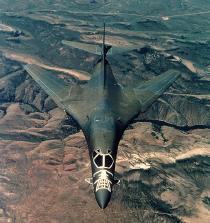
B1-B Lancer